

Welcome to the SLMN Blog

Shandong Linmo CNC Machine Tool Equipment Co., Ltd.
Insights, Tips, and More from SLMN CNC Machine Tools

Why Choose a 4 Axis CNC Vertical Machining Center for Precision Manufacturing?

In today's fast-paced manufacturing landscape, precision and efficiency are paramount. A 4 Axis CNC Vertical Machining Center stands out as a vital asset for industries seeking to enhance their production capabilities. According to a report by Grand View Research, the global CNC machine market is projected to reach $100 billion by 2025, driven by the growing demand for automated solutions that reduce human error and increase operational efficiency. CNC machines contribute to improved precision manufacturing, critical for sectors like aerospace, automotive, and medical equipment, where tolerances are tight and quality is non-negotiable.

The unique architecture of a 4 Axis CNC Vertical Machining Center allows for complex operations that traditional machining methods cannot achieve. This technology not only enables multi-directional cutting but also significantly decreases production time and enhances the machining of intricate components. Industry analysis by MarketsandMarkets indicates that the rise of advanced machining technologies is a key factor for manufacturers looking to maintain competitive advantages. By leveraging the capabilities of a 4 Axis CNC Vertical Machining Center, businesses can meet increasing customer demands while adhering to stringent quality standards, ultimately positioning themselves for success in an evolving market.

Why Choose a 4 Axis CNC Vertical Machining Center for Precision Manufacturing?

Advantages of 4 Axis CNC Vertical Machining Centers in Precision Engineering

Why Choose a 4 Axis CNC Vertical Machining Center for Precision Manufacturing?

The adoption of 4 Axis CNC Vertical Machining Centers in precision manufacturing is a strategic choice driven by several key advantages. One notable benefit is the enhanced complexity management. Unlike traditional 3-axis machines, 4-axis centers allow for the rotation of the workpiece, enabling manufacturers to perform intricate cuts and operations without the need for repositioning. According to a report by the International Federation of Robotics, incorporating an additional axis can improve productivity by up to 30%, as it reduces the setup time and increases the overall efficiency of the machining process.

Moreover, precision engineering often demands tighter tolerances, and 4-axis CNC machines excel in this regard. They are capable of achieving tolerances as tight as ±0.005 mm, making them suitable for industries such as aerospace and medical manufacturing where precision is critical. The enhanced tool paths facilitated by the fourth axis help minimize tool access issues and optimize cutting conditions, which not only elevates the quality of the machined parts but also extends tool life. A recent study from the Manufacturing Technology Association highlighted that businesses leveraging advanced machining technology, including 4-axis CNC, reported a 25% improvement in part consistency and a significant reduction in scrap rates.

Key Features of 4 Axis CNC Machines Enhancing Precision and Efficiency

Why Choose a 4 Axis CNC Vertical Machining Center for Precision Manufacturing?

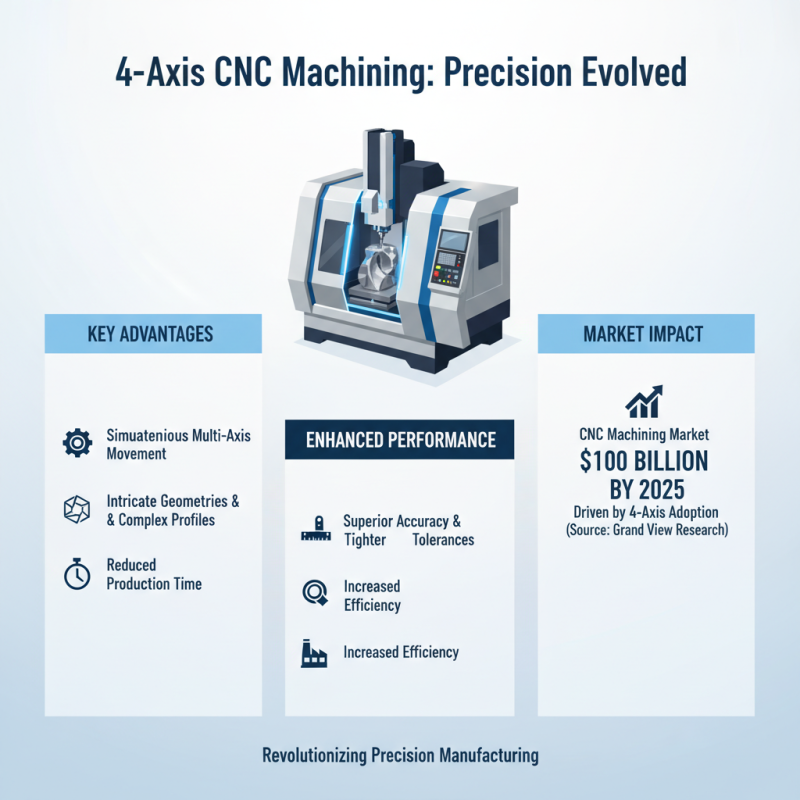
4 Axis CNC vertical machining centers are revolutionizing precision manufacturing by incorporating advanced features that significantly enhance both precision and efficiency. One of the key attributes of these machines is their ability to perform simultaneous multi-axis movements, allowing for intricate geometries and complex part profiles that traditional 3-axis machines cannot achieve. According to a recent industry report by Grand View Research, the CNC machining market is expected to reach $100 billion by 2025, driven largely by the adoption of 4 Axis technology which minimizes production time and maximizes accuracy, ensuring tighter tolerances on components.

The 4 Axis capability allows manufacturers to operate continuously without the need for manual repositioning of the workpiece. This automation not only accelerates production times but also reduces the potential for human error. Studies have shown that machining centers with advanced 4 Axis capabilities can increase productivity by up to 30%, which is crucial in today's competitive market. Furthermore, the integration of intelligent features such as adaptive machining and real-time monitoring provides operators with the tools to optimize processes, leading to enhanced output quality and resource efficiency. As manufacturing shifts toward more automated solutions, the strategic implementation of 4 Axis CNC machines becomes not just beneficial, but necessary for staying ahead in the precision manufacturing landscape.

Industry Applications: Where 4 Axis CNC Vertical Machining Centers Excel

In the realm of precision manufacturing, 4 Axis CNC Vertical Machining Centers have become indispensable tools across various industries. Their ability to perform complex machining operations with high accuracy and speed significantly enhances production capabilities. For instance, the aerospace industry has seen a marked improvement in efficiency and precision due to the utilization of 4 Axis CNC technology. According to a report by Global Industry Analysts, the global aerospace CNC machining market is projected to reach $5 billion by 2027, fueled by advancements in CNC technology that cater to the stringent requirements of aeronautical parts production.

Furthermore, the automotive sector has also reaped the benefits of 4 Axis CNC Vertical Machining Centers. These machines excel at producing intricate components, such as engine blocks and transmission housings, where tight tolerances and intricate designs are paramount. A study by TechSci Research highlighted that the global automotive CNC machine market is expected to grow at a rate of 7.5% during the forecast period of 2021-2026, driven by the need for higher precision and the increasing complexity of automotive part manufacturing. This trend underscores the critical role that 4 Axis CNC machines play in enabling manufacturers to meet the growing demands for high-quality products while maintaining competitive production times.

Comparative Analysis: 4 Axis Versus 3 Axis CNC Machining Centers

When considering precision manufacturing, the choice between a 4-axis and 3-axis CNC machining center is pivotal. The primary difference lies in the additional rotary axis offered by the 4-axis machines. This extra axis allows for more complex geometries and features to be machined in a single setup, reducing the need for repositioning the part. This is particularly beneficial for intricate designs and ensures higher accuracy and consistency in manufacturing processes.

In terms of efficiency, 4-axis CNC centers significantly enhance workflow. By allowing multiple sides of a workpiece to be accessed without the need for manual intervention, they reduce machine downtime and improve overall production speed. This is a game changer for industries where time is of the essence and precision is non-negotiable.

Tips for optimizing your CNC workflow include conducting thorough pre-job setup. Ensure the design files are compatible and all tools are calibrated. Regular maintenance checks on machinery can prevent unexpected downtimes. Lastly, investing time in training operators on the nuances of the 4-axis system will ultimately lead to improved outcomes and a smoother production experience.

Why Choose a 4 Axis CNC Vertical Machining Center for Precision Manufacturing? - Comparative Analysis: 4 Axis Versus 3 Axis CNC Machining Centers

Feature 3 Axis CNC Machining Center 4 Axis CNC Machining Center
Machining Complexity Limited to simple geometries Can handle complex shapes and contours
Part Orientation Requires manual setup for different orientations Automated rotation for all axes allows for continuous operation
Production Efficiency Lower efficiency for multi-sided parts Higher efficiency due to reduced setup time
Setup Time Higher, due to manual repositioning Lower, due to the ability to machine from all sides
Cost Generally lower initial investment Higher initial cost, but often justifiable by productivity gains
Ideal Applications Basic parts, 2D machining Complex parts such as molds, aerospace components

Cost-Benefit Analysis: Investing in 4 Axis CNC Technology for Manufacturers

Investing in a 4 Axis CNC Vertical Machining Center represents a strategic decision for manufacturers looking to enhance precision and efficiency in their production processes. The ability of 4 Axis machines to manipulate workpieces in multiple dimensions allows for complex geometries and intricate designs to be produced with remarkable accuracy. This capability not only reduces the need for multiple setups but also minimizes the risk of human error, leading to significant savings in both time and material costs.

From a cost-benefit perspective, the initial investment in 4 Axis CNC technology can be substantial. However, when considering the reduction in labor costs and the increase in manufacturing throughput, the long-term financial return often justifies the expense. Additionally, the precision of 4 Axis machining leads to higher quality products, which in turn enhances customer satisfaction and can result in increased sales. As manufacturers aim for sustainability and competitive advantage, the integration of 4 Axis CNC centers into their operations may prove to be not just an investment in equipment, but a commitment to operational excellence.

  • Address

    North of Industrial Road, Linqing Economic Development Zone,Liaocheng City, Shandong Province, China

  • Email

    info@lucimagnet.com

  • Phone/WhatsApp

    Angela:0086-13884742546
    Eric: 0086-15688878114

Get in touch with SLMN today. Whether you have questions about our CNC machine tools , or are interested in becoming a distributor, our team is ready to assist you.

© 2025 Shandong Linmo CNC Machine tool Equipment Co.,Ltd. All Rights Reserved.
Privacy Statement Terms & Conditions Sitemap

© 2025 Shandong Linmo CNC Machine tool Equipment Co.,Ltd. All Rights Reserved.

Privacy Terms & Conditions Sitemap